

Introduction
Grief is one of the most universal, yet deeply personal, human experiences. Whether it follows the death of a loved one, the end of a relationship, the loss of a job, or a life-altering diagnosis, grief has a way of reshaping how we move through the world. It rarely arrives on schedule, and it rarely leaves quietly. For some, grief softens with time and the support of family and friends. For others, it lingers, deepens, or resurfaces in unexpected ways, and it is in these moments that grief and loss therapy becomes not just helpful, but necessary.
This article looks at what grief and loss therapy actually involves in practice, the thinking that shapes how counselors work with grieving clients, and how to recognize when grief has moved from painful to unmanageable.

Understanding Grief
Grief is best understood as a response, not a diagnosis, the mind and body’s way of reacting to something that has been taken away. It shows up differently in every person. A widow might describe grief as a fog she cannot see through. A father who has lost a child might describe it as anger that has nowhere to go. A young adult grieving a friendship might not even recognize what they are feeling as grief at all, simply as a persistent sense that something is wrong.
Clinicians often separate grief (the internal experience of loss), mourning (the outward, often ritualized expression of that loss), and bereavement (the broader state of having lost someone or something significant). The distinction matters in therapy, because a client may be mourning appropriately by cultural standards while still carrying unresolved grief underneath.
Common Reactions to Grief
- Emotional, sadness, anger, guilt, anxiety, relief, loneliness
- Physical, fatigue, disrupted sleep, appetite changes, headaches, a weakened immune response
- Cognitive, trouble concentrating, disbelief, intrusive thoughts about the loss, confusion
- Behavioral, withdrawing from others, crying spells, searching for the person who is gone, disrupted routines
- Spiritual, questioning long-held beliefs, searching for meaning, existential doubt
Kübler-Ross and the Foundations of Grief Therapy
No single figure has shaped the modern understanding of grief more than psychiatrist Elisabeth Kübler-Ross. Her 1969 book, On Death and Dying, introduced what is now known simply as “the five stages”, denial, anger, bargaining, depression, and acceptance, and in doing so, gave language to an experience that had previously gone largely undiscussed in clinical settings.
Kübler-Ross developed her framework not from abstract theory but from sitting with terminally ill patients and listening to how they spoke about their own dying. What she observed was a pattern: an initial refusal to accept what was happening, followed by anger directed outward or inward, attempts to negotiate or delay the inevitable, a period of deep sadness as the reality set in, and, for some, though not all, a final sense of peace.
Take, for example, a client processing the sudden death of a spouse. In the early weeks, she may insist her husband will walk through the door any moment, unable to absorb the finality of what has happened, denial doing its protective work. As the fog lifts, anger often follows: at doctors, at fate, at the person for leaving. Bargaining might sound like quiet, private negotiations, promises made to a higher power in exchange for one more day. Depression sets in as the weight of permanence becomes undeniable. And acceptance, when it arrives, does not mean the pain is gone; it means she has found a way to carry it.
It is worth being honest about the limitations of this model, because Kübler-Ross herself acknowledged them later in her career. The stages were never meant to be linear, and they were never meant to apply to every kind of loss equally, her original observations came from dying patients reflecting on their own mortality, not from grieving survivors. In practice, a person may skip stages entirely, move through them out of order, or cycle back through anger long after they believed they had reached acceptance. A therapist who treats the five stages as a checklist risks doing more harm than good, subtly implying that a client is grieving “incorrectly” if their experience does not match the sequence.
Where the model earns its lasting influence is not as a rigid map, but as permission, permission for a client to feel angry without shame, to bargain without embarrassment, to sit in depression without being rushed toward acceptance. Used this way, in the hands of a skilled counselor, it remains one of the most useful entry points for helping a grieving person name what they are going through, even more than fifty years after it was first written down.

What Grief and Loss Therapy Looks Like in Practice
Grief counseling is rarely a single technique applied uniformly. A counselor might spend the first several sessions simply listening, letting a client describe the person or life they lost in as much detail as they want, without steering toward any particular outcome. Over time, sessions might shift toward identifying where a client feels stuck: perhaps in unrelenting guilt over words left unsaid, or in anger they feel unable to express to anyone else.
Some clients benefit from individual counseling, where the pace and depth of the work can be tailored entirely to them. Others find more relief in group settings, sitting alongside people who understand the particular weight of losing a parent, a child, or a partner without needing it explained. Families sometimes attend sessions together, especially when a loss has shifted roles within the household, a teenager suddenly expected to “be strong” for a parent, or siblings disagreeing about how to honor a shared loss.
For clients who struggle to put grief into words, a counselor might introduce journaling, letter-writing to the deceased, or other expressive exercises. These are not gimmicks; they are ways of accessing feelings that resist direct conversation.
When Grief Becomes Complicated
Most people move through grief without needing formal treatment. But for some, grief does not ease with time, it stays sharp, or even sharpens further, months or years after the loss. This is sometimes referred to clinically as prolonged or complicated grief, and it looks different from “ordinary” grief in a few key ways.
A person experiencing complicated grief might find that daily life still feels impossible a year or more after the loss. They may be unable to accept that the loss happened at all, avoid anything that reminds them of it, or feel that their own life effectively ended alongside the person they lost. Some describe a persistent numbness, a sense of being cut off from other people, even those closest to them.
If you recognize these patterns in yourself or someone you love, particularly alongside thoughts of self-harm or a loss of will to continue, reaching out to a licensed mental health professional is not optional, it is essential, and it should happen as soon as possible.
Why Grief Therapy Helps
People often arrive at grief counseling unsure of what to expect, and leave surprised by what it gave them: a place to say the things they could not say to family members trying to “stay strong,” a witness to their pain who was not also grieving, and, slowly, a sense that life could hold both sorrow and meaning at once.
Grief therapy does not erase loss. What it offers instead is company on the road through it, practical tools for the hardest days, a lower risk of the grief calcifying into depression or anxiety, and, eventually, the rebuilding of a life that includes the loss rather than one defined entirely by it.
Choosing the Right Grief Counselor
Not every therapist is trained specifically in bereavement work, and it is worth asking. A good grief counselor will be able to speak plainly about their approach, whether that leans on the Kübler-Ross framework, expressive therapies, family-systems work, or some combination shaped around the client. Just as important as credentials is the sense of safety in the room, grief work asks a person to be vulnerable, and that is only possible with someone they trust.
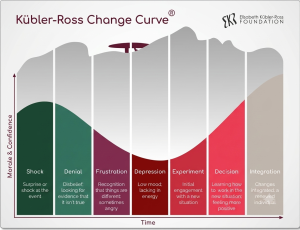
Kubler-Ross Change Curve
Conclusion
Grief is not a problem to be solved or a phase to be rushed through. It is, at its core, love with nowhere left to go, and therapy exists to help that love find a new place to rest. Elisabeth Kübler-Ross gave the world a language for dying and, by extension, for loss itself: the denial that protects us before we are ready, the anger that demands somewhere to land, the bargaining that reaches for control we no longer have, the depression that finally tells the truth, and, for many, though never on a fixed timeline, an acceptance that does not mean forgetting, but carrying.
Grief and loss therapy does not promise to make that carrying painless. It offers something more honest: a steady hand, a trained ear, and the reminder that no one has to carry it alone.
For those seeking compassionate, professional grief and loss counseling, Dove International Wellness Centre is an ideal place to visit. The centre offers a calm, supportive environment with experienced counselors dedicated to walking alongside individuals and families as they navigate loss and rebuild a sense of peace.
References
- Kübler-Ross, E. (1969). On Death and Dying. Macmillan.
- American Psychiatric Association. (2022). Diagnostic and Statistical Manual of Mental Disorders (5th ed., text rev.). Prolonged Grief Disorder.